Germany’s Visa-Free Transit Shift and India’s New Power Role
Germany’s surprise move to end transit visa rules for Indian travellers is more than a policy tweak. It signals Europe’s wider shift toward India as global power balances change fast both in Washington and in Beijing.
Germany’s Strategic Pivot Toward India: Why Berlin Ended Transit Visa Rules for Indians
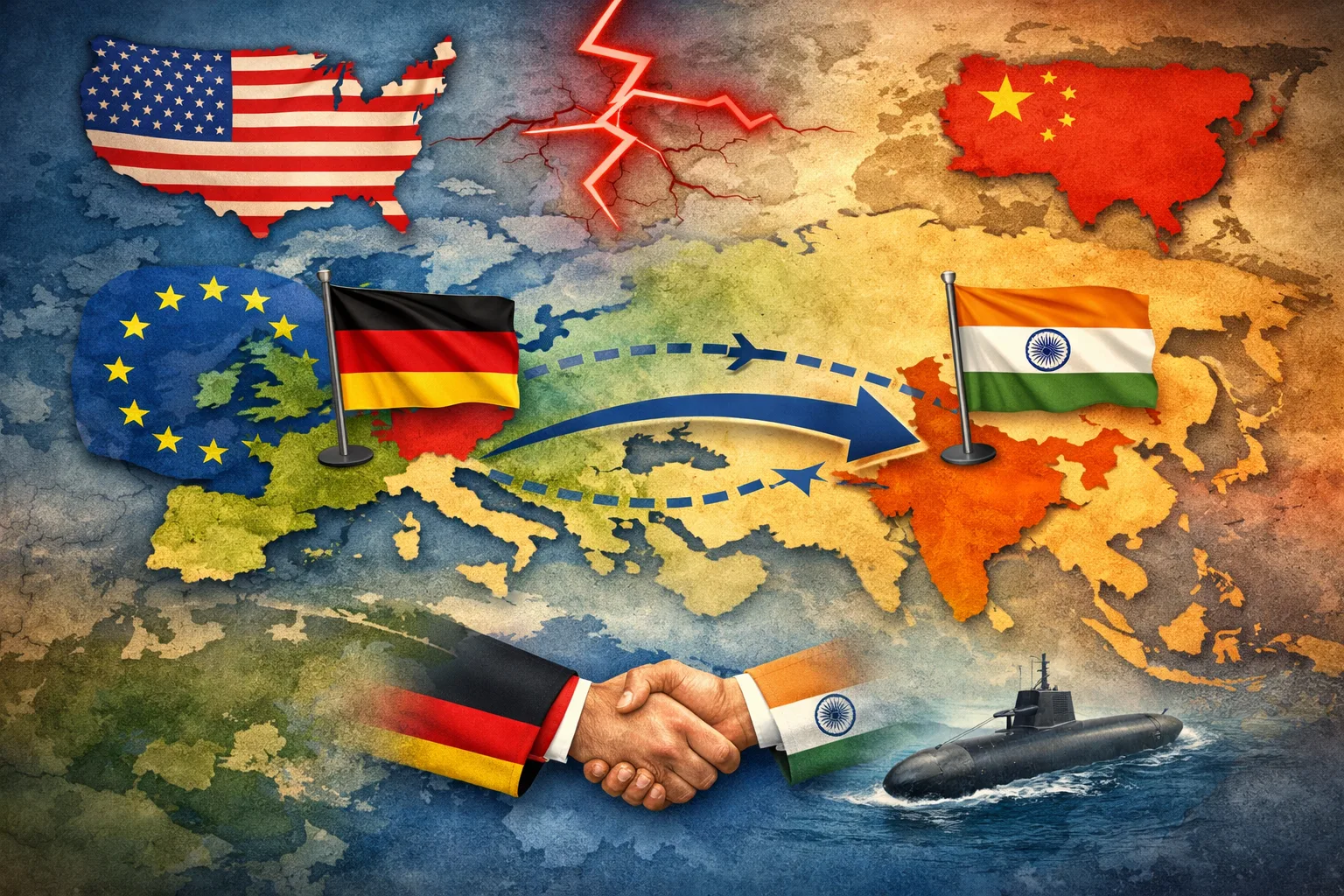
Europe has been uneasy for months, watching China’s assertiveness rise and Washington’s foreign policy turn increasingly unpredictable. Germany, sitting right at the centre of the European economic engine, seems to have reached a point where relying on either of these two giants no longer feels safe. And somewhere in that shifting world order, India has quietly moved into a position that Berlin can no longer ignore. What unfolded during the German Chancellor’s recent visit to New Delhi on 12–13 January is essentially Europe repositioning itself and India emerging as one of the few powers capable of balancing that change.
A World Order in Flux and Europe’s Search for Stability
Across the past few years, European capitals have repeatedly voiced concerns about their growing strategic dependence. China’s economic grip on critical supply chains keeps Western Europe on edge, but the deeper worry lately has come from the United States. Ever since Donald Trump re-entered the White House, his administration’s foreign-policy tone has shifted sharply. One day it is heavy tariffs, another day a threat to NATO’s future, and at times even remarks about attacking Greenland formally part of Denmark have floated around casually.
Also Read: Apple–Google AI Deal: Why Gemini Is Taking Over Siri
For Europe, especially Germany, this uncertainty is no longer a theoretical risk; it is a practical one. That is why Berlin has begun reducing its over-dependence on Washington, much like other European states. Britain has proposed deploying NATO forces for Greenland’s security, France is openly debating stepping back from NATO’s operational structure, and Italy has warned that any coercive American action could lead to the seizure of US bases on Italian soil. The message is the same everywhere: Europe wants strategic breathing room.
India Emerges as the Third Power in a Rebalanced World
In this global reshuffle, three powers now dominate the top tier:
the United States, China, and increasingly, India.
Whether measured through economic growth, defence manufacturing, military capability or diplomatic influence, India has moved into a position that major economies see as indispensable. Germany recognises this clearly. Not only is India the world’s fastest-growing large economy, it also holds a central geopolitical position in the Indo-Pacific something Europe is paying far more attention to than before.
Also Read: Greenland–US Conflict 2026
The German Chancellor’s Visit: A Symbolic and Strategic Milestone
The German Chancellor’s January visit to India wasn’t just ceremonial. It marked 75 years of India–Germany diplomatic relations and 25 years of their strategic partnership, giving both sides the perfect moment to recalibrate. The Chancellor spent time engaging with cultural events including the symbolic act of flying kites and then moved into far more consequential announcements.
The one decision that instantly dominated headlines was Germany’s move to allow visa-free airport transit for Indian passengers. The European Union is known for its strict Schengen rules, where even travellers who only pass through EU airports generally require transit visas. Germany broke this pattern entirely for Indians.
Why Germany Removed Transit Visa Requirements for Indians
Your original script captured the reason well: the shift is not random; it is rooted in Germany’s own anxieties. Berlin sees China as a major strategic threat. Simultaneously, depending fully on the US no longer feels viable. In such a climate, strengthening ties with India becomes not just diplomatic courtesy, but strategic necessity.
Also Read: AayulSAT Aims to Pioneer On‑Orbit Refuelling
Removing transit visas offers several advantages. Indians travelling to the UK, North America, or even within the EU often prefer transits through Frankfurt, Munich, or Berlin. These airports are among the busiest transit hubs in the world, and Germany wants to retain this status. Strict Schengen transit rules were pushing travellers toward Middle Eastern or Asian hubs. So this move is partly diplomatic, partly economic, and significantly geopolitical.
A Practical Relief for Indian Travellers
For Indian flyers, the benefit is immediate and tangible.
Earlier, a Schengen transit visa required fees, documentation, and long processing times even if the passenger never left the airport. Now, travellers can simply land in Germany, switch flights, and continue to London, Toronto, Paris, or anywhere else. This also reduces overall travel cost, which was previously inflated by visa charges.
Given Germany’s efficient airports and strong connectivity, this move is likely to pull a large section of India’s long-haul traffic back toward Europe.
Defence, Supply Chains, and an 8-Billion Dollar Submarine Project
The visit did not stop at mobility. Both sides held extensive discussions on defence cooperation, co-production opportunities, supply-chain resilience, and technology partnerships. One of the biggest topics on the table was the $8-billion submarine deal.
India’s current diesel-powered submarines lack Air Independent Propulsion (AIP) technology, which means they must frequently surface to take in oxygen. AIP-equipped submarines, however, can stay underwater much longer without surfacing. Germany is one of the world’s leaders in this technology. The proposed deal would significantly advance India’s naval endurance at a time when the Indo-Pacific is becoming increasingly contested.
Europe Needs India More Than It Admits Publicly
Underneath the diplomatic language, a clear pattern is emerging across Europe. France is pushing new defence arrangements with India. Italy and Germany are recalibrating their stances. Even countries that traditionally aligned tightly with Washington are building quiet parallel channels with New Delhi.
Europe sees India as a stable, democratic, economically dynamic counterweight in a world where China is aggressive and the US is unpredictable. That makes India a crucial partner not just for trade, but for balancing global systems.
A Turning Point in Europe–India Relations
Germany’s visa-free transit move may look like a small administrative tweak, but it reflects a deeper geopolitical pivot. Europe, for the first time in decades, is building independent security thinking without waiting for Washington’s approval. And in that fresh calculation, India sits firmly near the top.
For India, this creates both opportunities and responsibilities access to European technologies, smoother travel routes, and expanded defence partnerships, but also greater expectations as a stabilising actor in the global order.