Chabahar Reconsidered: Why New Delhi Hit the Strategic Brakes
Table of Contents
- The first signs of trouble
- A quiet exit nobody wanted to talk about
- A costly vacuum in India’s regional vision
- What changed? One word: sanctions
- Did Iran push back? Surprisingly, no
- Was this the U.S.’s intended outcome? Very likely
- But the biggest loss is not financial
- Is there any upside? A small one, yes
- What happens next?
- The quiet conclusion nobody wanted
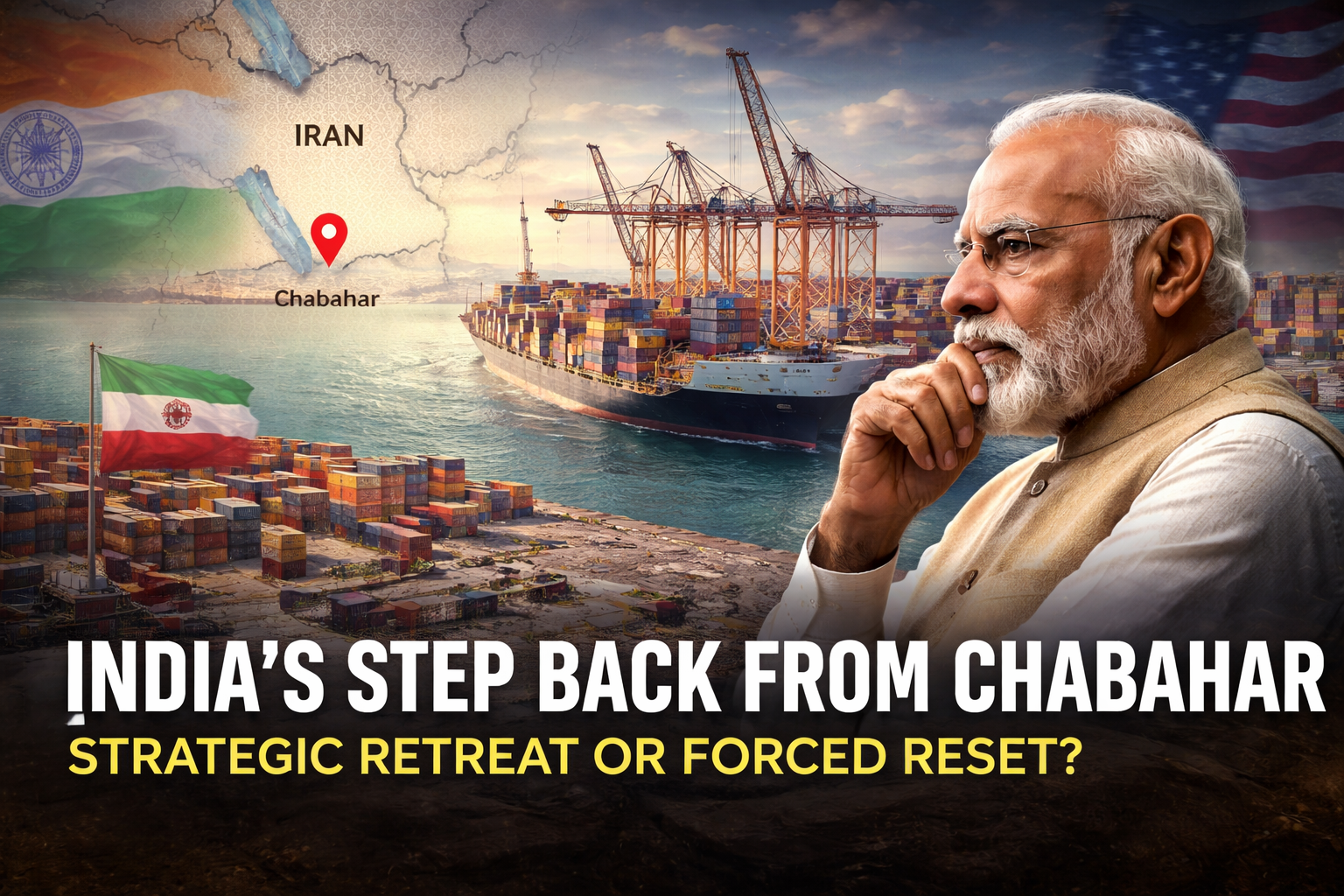
There are moments in geopolitics when a headline doesn’t just surprise you it unsettles you. And this one does exactly that. India, after years of involvement, enormous diplomatic balancing, and a sizeable financial commitment, has stepped back from the Chabahar Port project in Iran. The withdrawal wasn’t loud. It wasn’t ceremonious. It just surfaced, quietly, through well-placed sources, signalling something far deeper than a routine policy shift.
Anyone who has tracked India’s outreach to Central Asia knows the symbolic weight of this project. Chabahar was not merely a port. It was a corridor of hope, a bypass around Pakistan, a critical node for accessing Afghanistan, a counterweight to China’s Gwadar, and a strategic lever built painstakingly over nearly a decade.
And yet, all signs now indicate that New Delhi has executed what officials are calling a “strategic withdrawal.” The phrase itself sounds careful, almost defensive the kind of wording nations use when the truth is uncomfortable.
So what actually happened? And why now?
Let’s unpack everything.
The first signs of trouble
For months, analysts suspected that Washington’s pressure on Tehran would tighten in unpredictable ways. But even then, there was an assumption in New Delhi’s strategic circles that Chabahar would continue to receive a special exception, as it historically did.
Remember the reassurance from U.S. officials years ago “Chabahar is critical for Afghanistan’s stability”? That logic seemed rock-solid at the time. It helped India move ahead with port development, equipment installation, and operational commitments.
But then the political winds shifted in Washington.
The new administration’s sanctions matrix began expanding aggressively, and India found itself caught in the crossfire of a foreign policy reboot that didn’t care much for older exemptions. Suddenly, even the faint possibility of U.S. secondary sanctions became a live threat for Indian port authorities, banks, insurers, and any company remotely linked to the project.
Once that fear crept into boardrooms, the clock started ticking.
A quiet exit nobody wanted to talk about
The recent report suggests that India Ports Global Ltd. the joint venture responsible for operating the Shahid Beheshti terminal has essentially wound down operations. Directors have stepped down. The website, once active, is gone. Indian presence on-ground has thinned to almost nothing.
Officially, New Delhi has said nothing. Silence, as always in diplomacy, speaks loudest.
Insiders describe the disengagement as “systematic.” That word matters. It implies planning, not panic. India seems to have anticipated U.S. pressure months ahead and decided to wrap up before the sanctions hammer fell. In a way, the early payment of the entire $120 million commitment to Iran was also part of this cushioning strategy fulfil the promise, avoid penalties, maintain goodwill, and then step aside.
A pragmatic move, yes. But pragmatic decisions often carry hidden costs.
A costly vacuum in India’s regional vision
Let’s be blunt here: the withdrawal deals a heavy blow to India’s long-term connectivity plans. Chabahar was the southern gate of the International North–South Transport Corridor. With it, India envisioned cutting transport time to Russia by nearly half, reducing freight costs significantly, and establishing a logistics artery independent of volatile sea chokepoints.
More importantly, Chabahar gave India strategic visibility right next to Gwadar, the flagship China–Pakistan port that lies barely 170 kilometres away. Losing that vantage point doesn’t just sting it shifts equations.
You cannot watch the Indian Ocean’s evolving maritime choreography from a distance. Physical presence matters.
And now that presence is gone.
What changed? One word: sanctions
According to those familiar with the situation, the Indian side faced a crushing dilemma. If even a single Indian-flagged vessel, a bank transfer, or an equipment shipment got caught in the sanction net, the fallout could have rippled through India’s entire maritime ecosystem.
No major port authority certainly not Kandla or JNPT can afford that risk. These are arteries of India’s internal and external trade. Losing access to the U.S. financial system, even temporarily, would be catastrophic.
Geopolitics rarely offers perfect choices. Here, India had only two:
either suffer severe economic blowback for holding onto Chabahar,
or make a strategic retreat and hope to return later under better circumstances.
India chose the second.
Did Iran push back? Surprisingly, no
Despite the setback, Tehran isn’t furious. In fact, the tone from Iran remains surprisingly cordial. The reason is simple: the money is already in their hands. With $120 million transferred upfront, Iran now has complete freedom to upgrade port cranes, expand berths, acquire new handling systems, and operate the terminal independently.
The withdrawal stings, yes, but the financial component was honoured. That matters in diplomacy. Commitments kept are often remembered longer than the partnerships that collapse.
And if the geopolitical climate shifts a new U.S. president, a different sanctions architecture, or renewed regional incentives Iran has no reason to shut the door on India permanently.
In fact, that door may remain half-open.
Was this the U.S.’s intended outcome? Very likely
If you study Washington’s messaging over the last year, a pattern becomes obvious. Every time India sought clarity on Chabahar exemptions, the response was vague, almost deliberately so. One month there was reassurance, the next month an ambiguous warning.
This ambiguity created a predictable outcome: India had to hedge. And hedging, eventually, turned into withdrawal.
The recent 25% tariff threat on countries trading with Iran reinforces that Washington expected India to re-evaluate its Chabahar presence. In a world where supply chains and energy security are deeply dollar-dependent, even India had to yield.
That’s not weakness. That’s realpolitik.
But the biggest loss is not financial
India can absorb a $120 million loss. That figure barely matches the cost of a single advanced fighter jet. What India cannot easily replace is the strategic depth Chabahar provided.
Think about it:
• direct access to Afghanistan without Pakistan’s interference
• a halfway node to Central Asian markets
• an observation vantage point near Gwadar
• an anchor for the INSTC corridor
• a geopolitical balancing lever against China’s maritime expansion
All of this converged at Chabahar. Losing it is not just a tactical setback it reshapes the regional board.
Is there any upside? A small one, yes
India exits the project without lasting damage to its global economic footprint.
The U.S. sanction risk is neutralised.
Iran retains goodwill toward India.
The port may still accept Indian cargo indirectly through UAE intermediaries, as it often has.
And importantly, India retains the option to re-enter the arrangement if conditions shift dramatically.
Strategic doors rarely close forever.
What happens next?
Everyone is waiting for one thing: an official statement from India’s Ministry of External Affairs. If the MEA denies withdrawal, the entire narrative changes. If it confirms, then this is a historic pivot.
Even now, seasoned diplomats insist there is “room for re-engagement.” That phrase is intentionally vague the kind of phrasing countries use when they want to avoid burning bridges.
Iran, for its part, now carries the responsibility of proving Chabahar can thrive independently. If Tehran manages to modernise the port with the funds India already provided, it may emerge stronger, not weaker.
China, meanwhile, will read this development with interest. It already controls Gwadar. An India-less Chabahar creates a vacuum Beijing may try to influence subtly.
And Pakistan? It gains strategic comfort simply by virtue of India stepping back.
The quiet conclusion nobody wanted
India’s departure from Chabahar was not a failure of ambition. It was the collision of two hard realities: U.S. sanctions leaving no manoeuvring room, and India’s desire to protect its broader economic architecture from collateral damage.
It is a setback, undeniably. But it is also not irreversible.
Geopolitics moves in cycles. Today’s retreat may become tomorrow’s re-entry.
For now, India has chosen caution over confrontation.
And the world especially the region will feel the shift.